

Recasting Alarm as Sin
Language that recodes fear, anger, grief, and empathy as spiritual failure.

The sixth and final spoke in the Wheel of Reality-bending Phrases is Recasting Alarm as Sin. This is similar to discrediting the truth-teller, but here the focus is primarily on the nature and expression of certain concerns and their accompanying emotions, not on the person bringing the concern (although there can be much overlap).
The Wheel of Reality-Bending Phrases

There are phrases designed to end conversation by bending reality.
I once sat across from a leader who heard my concerns over how vulnerable individuals were being mistreated and was asked, “When did this root of bitterness start growing in you?” It wasn’t the response I expected. Suddenly my concern was recast as a sin: a flaw in my character that needed investigation more than the concerns I raised.
I’ve also sat in audiences as leaders addressed harm they caused and told their followers that there was nothing to be concerned about, that leadership needed to be trusted, that perfect love casts our fear, that anger will only cause division and destruction, and it would be best if everyone could move forward and get back “on mission.”
There are four categories of expressions of alarm I want to highlight. Each tends to be recast as sin by a reality-bending environment (or what I’ve called a Gaslight Religion). These are fear, anger, grief, and empathy.
One of the things I’ve noticed over the years is that these emotions rarely arise in isolation from reality. They are responses. Each of these emotions bears witness to a different kind of reality. They are not random interruptions to be overcome or inconvenient feelings to suppress. They are forms of alarm. They arise because something significant is being perceived or experienced. Fear alerts us to danger. Anger protests injustice. Grief mourns loss. Empathy awakens us to the suffering of another. Like warning lights flashing on the dashboard of a car, they are not the problem themselves. They are drawing our attention toward something that deserves to be understood. While they are not infallible guides, neither are they enemies. They are part of the way we come to make sense of what is happening to us and around us.
The deeper question beneath these emotions is “What reality is this feeling inviting me to see?”
Reality-bending recasts alarm by disconnecting the accompanying emotions from the reality those emotions might be trying to reveal. Fear is disconnected from danger and attached to a lack of faith. Anger is disconnected from injustice and attached to bitterness. Grief is disconnected from loss and attached to being stuck or an unwillingness to “move on.” Empathy is disconnected from suffering and attached to partiality and blindly “taking sides.” As a result, reality-bending redirects alarm back onto the person expressing it.
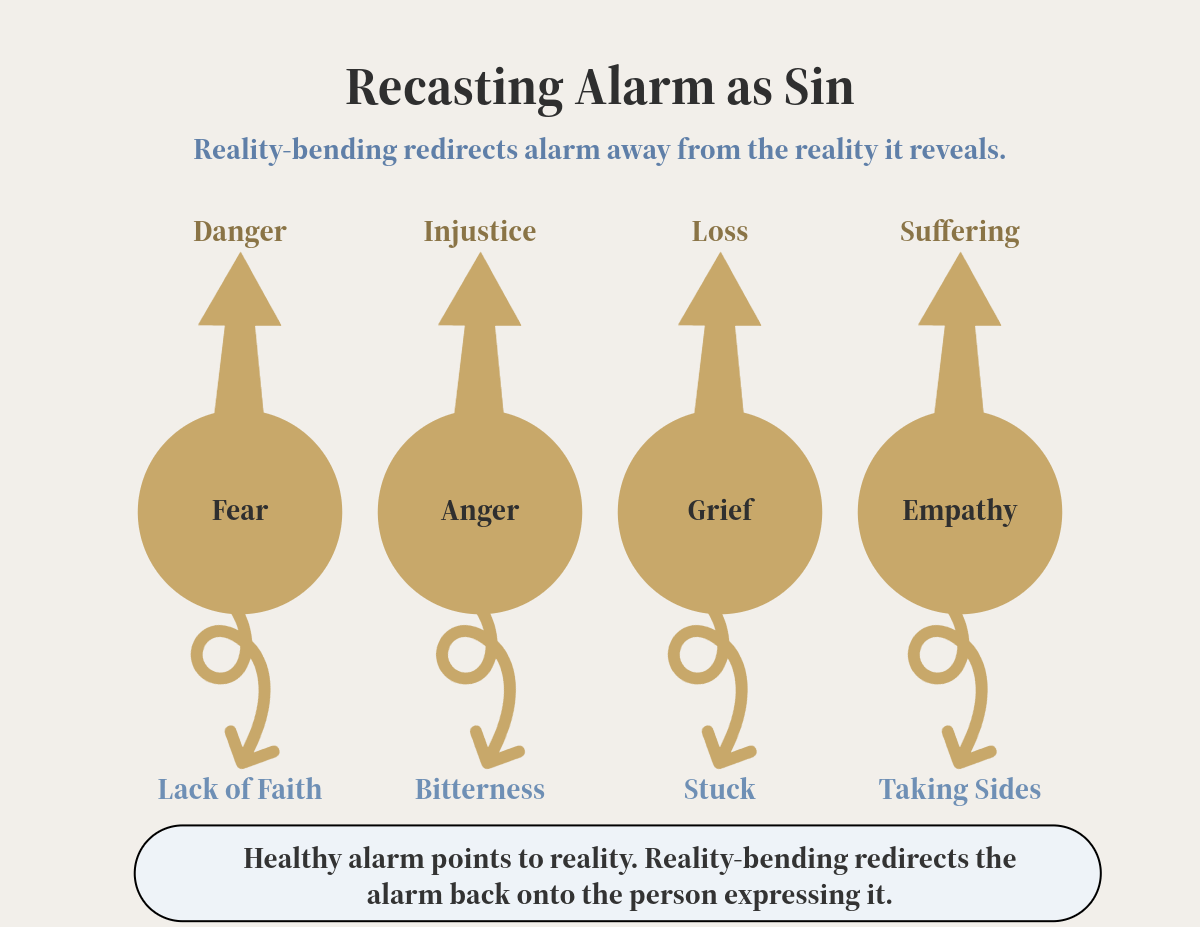
Keep in mind that these categories, like the other categories I’ve developed in this series, are just points on a map meant to guide thought and dialogue. They are like most maps of a landscape: they give you a sense of where to find landmarks and paths, but are only meant as a guide and cannot substitute for the actual experience of exploring the terrain yourself. They can’t capture all of the complexities of reality, especially when seeking to understand human relationships and their many interactions.
Missing Feedback
One of the distinguishing attributes I’ve found among healthy systems that coercive systems struggle to maintain is resilience. A healthy system is remarkably resilient because it accepts and learns from difficult feedback, while an unhealthy system is constantly rescuing itself from imminent collapse and shunning unwanted feedback. That’s not to say a coercive system can’t continue for a very long time, but it becomes increasingly brittle.
System thinker Donella Meadows described resilience as the capacity of a system to absorb disturbances and reorganize while undergoing change, without losing its essential character. She imagined a resilient system as a wide plateau upon which the community can move and breathe and even stumble, bounded by gentle, elastic walls that redirect rather than punish. There is room to wander. There is room to ask hard questions, express uncomfortable emotion, to dissent, to fail and make amends.
Healthy systems become resilient precisely because they receive feedback. They see alarm as an early warning signal and an opportunity to learn and correct course rather than as a threat to power. Coercive systems often do the opposite. Rather than receiving alarm as feedback, they redefine the alarm as the problem. By rejecting the very feedback that could lead to repair, they slowly lose the resilience they are trying to protect.
Fear, anger, grief, and empathy are part of a healthy system’s ability to perceive reality. But a coercive system disables the very feedback that would allow it to recognize and correct its own failures. And as Meadows writes, “Missing feedback is one of the most common causes of system malfunction.”
Toxic Positivity
In the absence of honest feedback that includes emotions like fear, anger, grief, and empathy, an environment can become characterized by toxic positivity, where certain emotions (those perceived as positive) are welcome and others (those perceived as negative) are unwelcome.
The Yale Center for Emotional Intelligence developed a Mood Meter designed to help people recognize, understand, label, express, and regulate emotions (R.U.L.E.R. method). It’s a helpful tool for understanding the range of human emotion and why some situations call for different emotions.
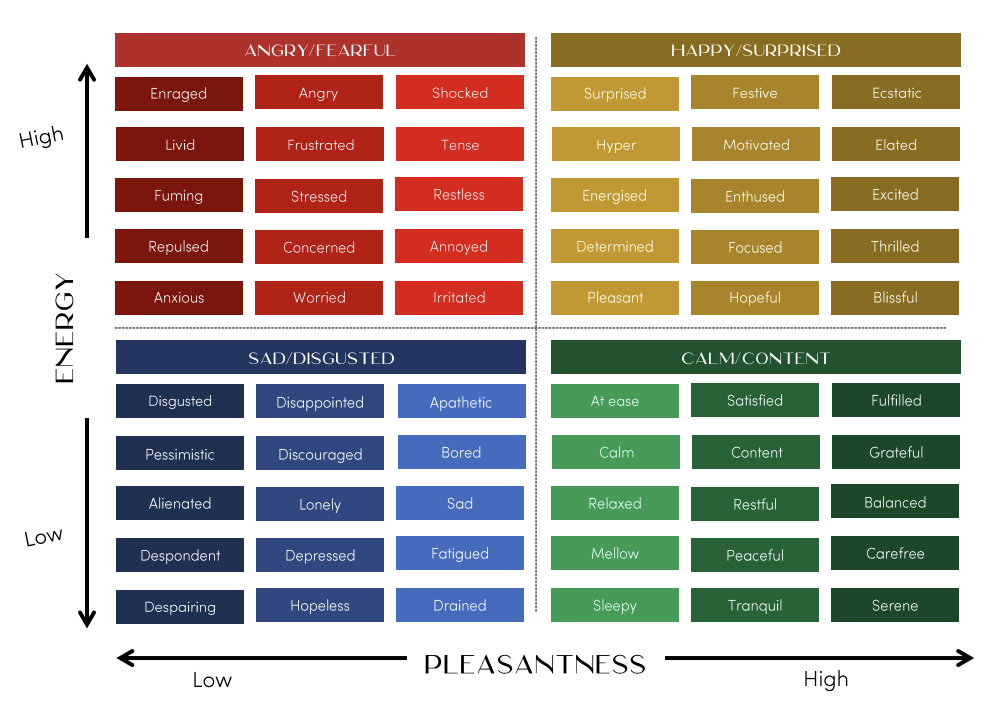
Within a culture of toxic positivity, people must remain pleasant or risk being discredited. The emphasis becomes one of keeping individuals in the more acceptable yellow and green quadrants and away from the more disruptive red and blue quadrants.
This toxic positivity creates stigmas around emotions that are viewed as negative. Erving Goffman described a stigma as an undesired differentness from what was expected that causes others to turn away from the person with the stigma. When leaders, for instance, manufacture an unending performance of positivity and expect their audiences to become applause machines, anything other than praise and acceptance becomes an undesired differentness - a stigma that results in the rejection of the one holding unwanted emotions.
In many toxic environments, these stigmas are hidden, or concealed, as people tend to keep unwelcome emotions suppressed. A coercive environment or relationship is filled with concealed stigmas. Expressions of emotions like anger and grief are made into discreditable attributes, providing a ready-made mechanism for discrediting, or stigmatizing, anyone who makes those emotions visible. As a result, alarms like fear, anger, grief, and empathy become either held but concealed or revealed but condemned. And the more they are condemned, the more they are concealed.
Recasting Fear
Fear is a normal response to danger. It is a gift, says Gavin De Becker, and should be embraced. An abusive relationship or institution may begin with a lot of charm, but when that charm is a tactic of control and not genuine kindness, then it’s as if you’ve received packages labeled as love but containing coercion and fear. Or it’s as if you’ve been played a certain tune but false notes start appearing, and these notes begin to suggest to you that charm might become harm the moment coercive demands are not met.
Because any expressions of fear might expose exploitation and danger, reality-bending phrases are used to convince others to deny that danger. When fear points to the reality of potential harm, those causing that harm might produce denial and argue that those who are fearful lack faith, trust, and love.
While harmful behavior might be episodic and cycle out of the picture for a time, the fear produced by the harm tends to persist, and becomes a constant force within future interactions. The relationship becomes unanchored as you can no longer predict when you might experience another episode of harm. Unanchored fearful interactions are a characteristic of a gaslighting-based relationship. It’s that gut sense telling you, “This is going to happen again.” That sense is likely based on communication - signs and signals - telling you this behavior is a pattern and not just an anomaly. This is especially true when harmful behavior goes unchecked and the person responsible chooses reality-bending phrases when giving an account for their actions rather than choosing truth and repair.
Fear, properly received rather than recast, can become wisdom.
Recasting Anger
Anger is a normal response to injustice and betrayal. Unjust violations and losses deserve anger. But in a gaslighting-based relationship or institution, all expressions of anger tend to be recast as sin and used to silence and discredit. When expressions of anger threaten to expose injustice, those perpetuating injustice might use reality-bending phrases to warn against bitterness and the destruction anger is said to cause, as if the anger is a spark that will burn everything down if it is not quickly stamped out.
But anger in the face of injustice is not a reckless attempt to take a wrecking ball to everything the powerful have built, but can be a virtuous and loving effort to free one’s self and others trapped behind those walls. Strong, sustained action in the service of justice sometimes requires strong emotion.
So when anger points to injustice, the unjust bend reality so that the anger points inward to the character flaws of the angry. One of the ways oppression thrives is through the stigmatization of certain virtues and character traits, especially righteous anger. Concerns are reduced to matters people just need to “get off their chest” in order to feel better. Expressions of anger are attributed to a “root of bitterness” or desire for revenge. But when the prophet Nehemiah learned of injustice, he became “extremely angry” and after considering the matter, confronted the leaders in the presence of others and said, “What you are doing is not right.” Sometimes we need Nehemiah moments. We need people, especially those with authority and responsibility, to get angry over injustice and speak up.
Anger, properly received rather than recast, can become courage.
Recasting Grief
Grief is a normal response to loss. But in a gaslighting-based relationship or institution, expressions of sadness and grief tend to be recast as weakness and an inability or unwillingness to move on. When expressions of grief threaten to expose the losses caused by injustice, those responsible might bend reality so that the grief points inward to something wrong with the griever.
The reality, however, is that abuse inflicts incalculable loss. This may include the loss of safety, personal meaning and mission, identity, choice, voice, relationships, opportunities, understanding, support, and much more. And they are not only losses, but they are unjust losses, not a loss caused by tragedy, time, change, and the types of losses we all inevitably face, but losses inflicted for another’s gain. This is why I think abuse is a form of theft: it misuses power to dispossess and rob another.
Expressions of unjust loss have the potential to expose this theft and greed, so those threatened by that exposure might use reality-bending phrases to deny or minimize those losses and stigmatize those who grieve.
Grief, properly received rather than recast, can become remembrance.
Recasting Empathy
Empathy is a normal response to the suffering of others. Many who’ve made the choice to speak up about their own experiences did so after learning about others who had experienced similar harm. They feel a burden for them and any others who might be suffering in silence or might be victimized in the future. They understand the loss and grieve with those who grieve. Empathy points to a shared loss that goes beyond the experience of just one person.
Empathy is a virtue. But in a gaslighting-based relationship or institution, empathy is recast as sin, perhaps because it is viewed as a galvanizing and coalescing force that might transform individual experiences of loss into collective lament and action. After all, a collection of voices is much more difficult to control than a single voice.
Every abusive system depends, to some degree, on isolation. Isolation keeps people questioning themselves instead of comparing stories. One person experiencing fear or anger may wonder if they are overreacting. One person who grieves may question whether the loss is really as significant as it feels. One person who has been coerced may spend years wondering whether the problem lies within themselves. But two people with similar experiences realize they aren’t imagining things. A group of people who have suffered or observed the same concerns discover a systemic pattern.
Coercive systems survive by separating people from one another and maintaining this isolation, like an archipelago whose separate islands slowly drift apart from each other. Empathy is found among those who do the opposite work, gathering what has been scattered and reconnecting stories that were kept apart. It interrupts that isolation and allows another person to step into the same reality and say, “I see it too.” It allows people living on separate islands to discover they have been standing on the shores of the same sea. Perhaps this is one reason coercive environments so often fear empathy.
Empathy, properly cultivated rather than recast, can become solidarity.
Reclaiming Reality
One of the ways I’ve learned to resist and counteract reality-bending messages is to revisit the cause for alarm and allow it to point me back toward the reality it may be trying to reveal. Reality-bending phrases ask us to examine the emotion before examining what gave rise to it. Why are you so fearful? Why can’t you let this go? Are you just bitter? Are you overreacting? The alarm itself becomes suspect, as though the concern tells more about the one experiencing it than about the reality being experienced.
I’ve found it helpful to ask questions that point in the opposite direction of where gaslighting seeks to bend reality. What danger might fear be trying to draw my attention toward? What injustice is my anger refusing to ignore? What has been lost that deserves to be named and mourned? What keeps drawing me toward the suffering of another? What burden have they been carrying that perhaps no one else has been willing to see? These questions do not assume that every emotion is beyond examination. Fear, for example, can misjudge danger and anger can become destructive. But neither do these questions assume the alarm itself is the problem. The important thing is to not dismiss it before listening to what it may be trying to communicate.
One of the practices I’ve found most helpful is to take an inventory of these alarms. I return to the moments where fear emerged, where there was cause for anger, where grief settled in, where empathy refused to ignore another’s suffering, and I ask what truths those moments may have been pointing toward all along. Depending on your circumstances, this may be an exercise best done with a trusted friend, advocate, counselor, or therapist. But I’ve often found that returning to simple questions like What is true? What happened? What has been the impact? has a way of slowly turning the map right-side up again and reclaiming the reality that has been bent.
Perhaps that is one of the clearest differences between gaslighting and healthy environments. One treats expressions of alarm and concern as threats to be silenced. The other receives them as witnesses to reality.
The part I see most from the counseling room is what happens after enough exposure: the phrases install themselves. The system eventually needs no spokesman, because the person does the recasting alone. Fear arrives and they hear “where is your faith” in their own voice before anyone speaks. Grief surfaces and they accuse themselves of refusing to move on. The gaslight becomes self-administering, which is why leaving the environment ends the messaging but not the mechanism. Recovery asks for something slower than exit: relearning to receive your own alarms as witnesses again. Your inventory practice names the counter-move exactly. The alarm was testifying all along. Witnesses can be recalled.
Thanks for sharing!
I have appreciated this series--and all of your work--so much as I have walked through a difficult season. Thank you for bringing clarity and compassion when the world is tipped upside down.